Pena Palace
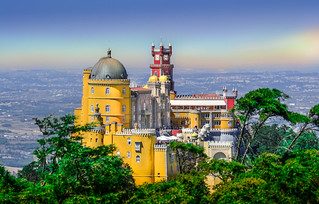
Pena Palace crowns a rocky summit in the Sintra Mountains above Lisbon, its vivid towers visible for miles. A Hieronymite monastery founded by King Manuel I stood here until the 1755 Lisbon earthquake reduced it to ruins. In 1838 King Ferdinand II acquired the site and commissioned German architect Wilhelm Ludwig von Eschwege to design a royal summer residence; construction ran from 1842 to 1854. The palace blends Neo-Gothic, Neo-Manueline, Neo-Islamic, and Neo-Renaissance styles in a Romantic extravaganza, with Ferdinand personally contributing to the design of its sculpted archways.
After the 1910 republican revolution it was classified as a national monument and museum. Today it is a UNESCO World Heritage Site and one of Portugal's Seven Wonders, open year-round.
Visitor information
- Location
- Sintra
- Country
- Portugal
- Tier
- A (Magnificent, well worth a dedicated trip)
- Coordinates
- 38.7878, -9.3906
- Official site
- http://www.parquesdesintra.pt/parques-jardins-e-monumentos/parque-e-palacio-nacional-da-pena/
Frequently asked questions
- Where is Pena Palace?
- Pena Palace is in Sintra, Portugal (approximately 38.7878, -9.3906).
- Can you visit Pena Palace?
- Yes — Pena Palace is open to visitors; see the official site at http://www.parquesdesintra.pt/parques-jardins-e-monumentos/parque-e-palacio-nacional-da-pena/ for hours and tickets.
- What tier is Pena Palace on the Castle Atlas?
- Pena Palace is rated A tier on the Castle Atlas — Magnificent, well worth a dedicated trip.
- What can you see at Pena Palace?
- Pena Palace crowns a rocky summit in the Sintra Mountains above Lisbon, its vivid towers visible for miles. A Hieronymite monastery founded by King Manuel I stood here until the 1755 Lisbon earthquake reduced it to ruins. In 1838 King Ferdinand II acquired the site and commissioned German architect Wilhelm Ludwig von Eschwege to design a royal summer residence; construction ran from 1842 to 1854. The palace blends Neo-Gothic, Neo-Manueline, Neo-Islamic, and Neo-Renaissance styles in a Romantic extravaganza, with Ferdinand personally contributing to the design of its sculpted archways.