Gravensteen
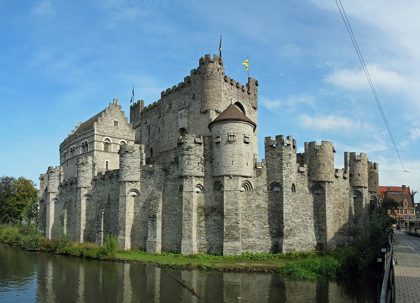
Gravensteen was built in 1180 by Philip of Alsace, Count of Flanders, using sandstone and Tournai limestone. Its oval curtain wall is lined with 24 projecting turrets and a moat fed from the River Lys. The central keep served as the residence of the Counts of Flanders until 1353, after which the castle became a mint, court, prison, and cotton spinning mill before a restoration of 1893–1907 returned it to its medieval silhouette.
On 16 November 1949, some 138 students occupied the castle, lowered the portcullis, and barricaded the gate to protest a beer tax — an episode Ghent still celebrates as the Battle of Gravensteen. It is open to the public as a museum housing medieval weapons and judicial instruments.
Visitor information
- Location
- Ghent
- Country
- Belgium
- Tier
- B (Great castles)
- Coordinates
- 51.0572, 3.7206
- Official site
- https://visit.gent.be/nl/zien-doen/gravensteen-een-burcht-gent
Frequently asked questions
- Where is Gravensteen?
- Gravensteen is in Ghent, Belgium (approximately 51.0572, 3.7206).
- Can you visit Gravensteen?
- Yes — Gravensteen is open to visitors; see the official site at https://visit.gent.be/nl/zien-doen/gravensteen-een-burcht-gent for hours and tickets.
- What tier is Gravensteen on the Castle Atlas?
- Gravensteen is rated B tier on the Castle Atlas — Great castles.
- What can you see at Gravensteen?
- Gravensteen was built in 1180 by Philip of Alsace, Count of Flanders, using sandstone and Tournai limestone. Its oval curtain wall is lined with 24 projecting turrets and a moat fed from the River Lys. The central keep served as the residence of the Counts of Flanders until 1353, after which the castle became a mint, court, prison, and cotton spinning mill before a restoration of 1893–1907 returned it to its medieval silhouette.