Neuschwanstein Castle
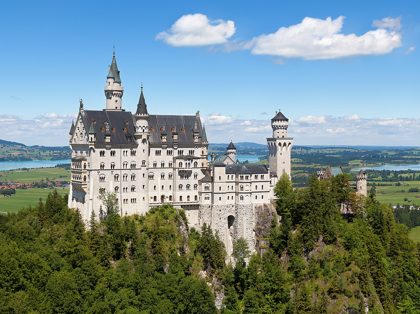
Neuschwanstein Castle crowns a rocky ridge above Hohenschwangau in the Bavarian Alps near Füssen. King Ludwig II commissioned it in 1869 as a private retreat inspired by medieval chivalry and Wagner's operas; architect Eduard Riedel and stage designer Christian Jank realized his vision in Neo-Romanesque style. Ludwig spent only 172 days there before his death in 1886, and the castle was never finished — a planned 90-meter round tower with its three-nave chapel was never built, and only about 15 rooms were completed.
It opened to the public just six weeks after Ludwig died and today draws roughly 1.5 million visitors a year on mandatory guided tours. A meteorite discovered near Hohenschwangau in 2002 was officially named Neuschwanstein in the castle's honor.
Visitor information
- Location
- Schwangau, Bavaria
- Country
- Germany
- Tier
- S (The absolute cream of the castle crop)
- Coordinates
- 47.5575, 10.7494
- Official site
- https://www.neuschwanstein.com/
Frequently asked questions
- Where is Neuschwanstein Castle?
- Neuschwanstein Castle is in Schwangau, Bavaria, Germany (approximately 47.5575, 10.7494).
- Can you visit Neuschwanstein Castle?
- Yes — Neuschwanstein Castle is open to visitors; see the official site at https://www.neuschwanstein.com/ for hours and tickets.
- What tier is Neuschwanstein Castle on the Castle Atlas?
- Neuschwanstein Castle is rated S tier on the Castle Atlas — The absolute cream of the castle crop.
- What can you see at Neuschwanstein Castle?
- Neuschwanstein Castle crowns a rocky ridge above Hohenschwangau in the Bavarian Alps near Füssen. King Ludwig II commissioned it in 1869 as a private retreat inspired by medieval chivalry and Wagner's operas; architect Eduard Riedel and stage designer Christian Jank realized his vision in Neo-Romanesque style. Ludwig spent only 172 days there before his death in 1886, and the castle was never finished — a planned 90-meter round tower with its three-nave chapel was never built, and only about 15 rooms were completed.