Olavinlinna
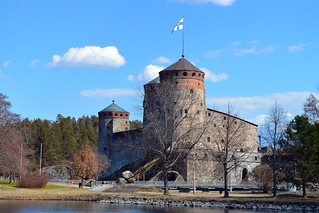
Olavinlinna is a three-towered medieval stone fortress on a rocky island in the Kyrönsalmi strait at Savonlinna, Finland. Founded in 1475 by Erik Axelsson Tott to defend Sweden's eastern frontier against Russian expansion, it is the northernmost medieval stone castle still standing. Its circular towers were built to withstand cannon fire.
It repelled Russian sieges in 1495–1497 and 1554–1557, but the garrison surrendered twice — in 1714 and 1743 — ceding the region to Russian rule. The castle houses a Castle Museum and an Orthodox Museum. Since 1912, when soprano Aino Ackté launched the tradition, it has served as the venue for the Savonlinna Opera Festival, one of opera's most dramatic natural settings.
Visitor information
- Location
- Savonlinna
- Country
- Finland
- Tier
- C (Worth a visit if you're already in the area)
- Coordinates
- 61.8639, 28.9011
- Official site
- https://www.kansallismuseo.fi/fi/olavinlinna/etusivu
Frequently asked questions
- Where is Olavinlinna?
- Olavinlinna is in Savonlinna, Finland (approximately 61.8639, 28.9011).
- Can you visit Olavinlinna?
- Yes — Olavinlinna is open to visitors; see the official site at https://www.kansallismuseo.fi/fi/olavinlinna/etusivu for hours and tickets.
- What tier is Olavinlinna on the Castle Atlas?
- Olavinlinna is rated C tier on the Castle Atlas — Worth a visit if you're already in the area.
- What can you see at Olavinlinna?
- Olavinlinna is a three-towered medieval stone fortress on a rocky island in the Kyrönsalmi strait at Savonlinna, Finland. Founded in 1475 by Erik Axelsson Tott to defend Sweden's eastern frontier against Russian expansion, it is the northernmost medieval stone castle still standing. Its circular towers were built to withstand cannon fire.