Bojnice Castle
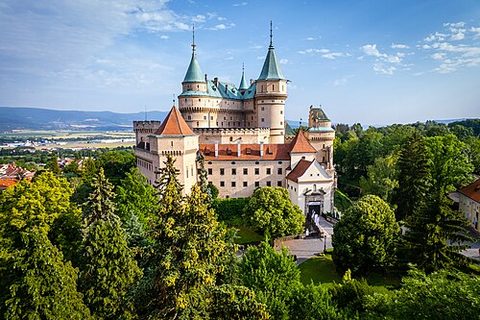
Bojnice Castle rises from a travertine rock in Bojnice, western Slovakia, its silhouette of pointed towers one of the country's most recognisable. A wooden stronghold is documented here from 1113; it was rebuilt in stone in the 13th century and passed through several powerful dynasties, including Matúš Čák and Matthias Corvinus, who reportedly signed royal documents beneath a linden tree that still stands on the grounds some 700 years later.
The castle's current Romantic Neo-Gothic appearance dates to a reconstruction by Count János Ferenc Pálffy between 1889 and 1910, modelled on Loire Valley châteaux. It is now open to the public as a museum administered by the Slovak National Museum.
Visitor information
- Location
- Bojnice
- Country
- Slovakia
- Tier
- A (Magnificent, well worth a dedicated trip)
- Coordinates
- 48.78, 18.5778
- Official site
- https://bojnicecastle.sk
Frequently asked questions
- Where is Bojnice Castle?
- Bojnice Castle is in Bojnice, Slovakia (approximately 48.78, 18.5778).
- Can you visit Bojnice Castle?
- Yes — Bojnice Castle is open to visitors; see the official site at https://bojnicecastle.sk for hours and tickets.
- What tier is Bojnice Castle on the Castle Atlas?
- Bojnice Castle is rated A tier on the Castle Atlas — Magnificent, well worth a dedicated trip.
- What can you see at Bojnice Castle?
- Bojnice Castle rises from a travertine rock in Bojnice, western Slovakia, its silhouette of pointed towers one of the country's most recognisable. A wooden stronghold is documented here from 1113; it was rebuilt in stone in the 13th century and passed through several powerful dynasties, including Matúš Čák and Matthias Corvinus, who reportedly signed royal documents beneath a linden tree that still stands on the grounds some 700 years later.