Bratislava Castle
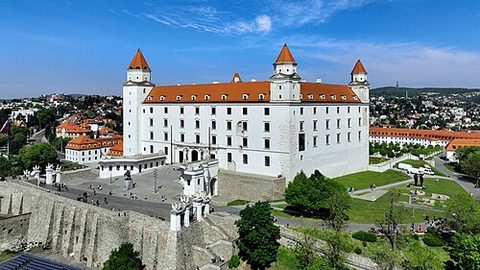
Bratislava Castle crowns a rocky spur above the Danube in Slovakia's capital, a site with some 4,500 years of documented settlement. The stone fortress evolved through Romanesque, Gothic, Renaissance, and Baroque phases, with major reconstruction under King Sigismund in the 1430s and under Empress Maria Theresa between 1761 and 1766.
From 1536 to 1784 it served as the seat of Royal Hungary, and from 1552 to 1784 it safeguarded the Holy Crown of Hungary. A fire on 28 May 1811 left it a ruin; restoration construction began in 1957 after archaeological surveys in 1953. Today the castle houses the Slovak National Museum and is open to visitors.
Visitor information
- Location
- Slovakia
- Country
- Slovakia
- Tier
- B (Great castles)
- Coordinates
- 48.1422, 17.1
- Official site
- http://www.bratislava-hrad.sk/
Frequently asked questions
- Where is Bratislava Castle?
- Bratislava Castle is in Slovakia, Slovakia (approximately 48.1422, 17.1).
- Can you visit Bratislava Castle?
- Yes — Bratislava Castle is open to visitors; see the official site at http://www.bratislava-hrad.sk/ for hours and tickets.
- What tier is Bratislava Castle on the Castle Atlas?
- Bratislava Castle is rated B tier on the Castle Atlas — Great castles.
- What can you see at Bratislava Castle?
- Bratislava Castle crowns a rocky spur above the Danube in Slovakia's capital, a site with some 4,500 years of documented settlement. The stone fortress evolved through Romanesque, Gothic, Renaissance, and Baroque phases, with major reconstruction under King Sigismund in the 1430s and under Empress Maria Theresa between 1761 and 1766.