Marksburg
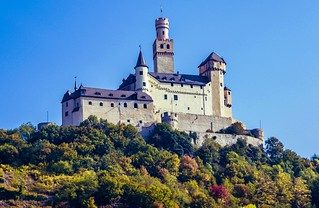
Marksburg rises 186 metres above Braubach on the Middle Rhine, Germany, and is the only medieval hilltop castle on the Rhine never destroyed or left in ruin. Fortifications existed by around 1117, possibly under the House of Eppstein; the Counts of Katzenelnbogen drove major Gothic expansions from around 1350 onwards. The bergfried features a distinctive butter-barrel tower added in 1468.
Part of the UNESCO Upper Middle Rhine Valley World Heritage Site (inscribed 2002), the castle has been run by the German Castles Association since 1900. Open to visitors year-round, it draws around 200,000 tourists annually and houses medieval armour, period furnishings, and a reconstructed herb garden.
Visitor information
- Location
- Braubach, Rhineland-Palatinate
- Country
- Germany
- Tier
- C (Worth a visit if you're already in the area)
- Coordinates
- 50.2718, 7.6492
- Official site
- http://www.marksburg.de/
Frequently asked questions
- Where is Marksburg?
- Marksburg is in Braubach, Rhineland-Palatinate, Germany (approximately 50.2718, 7.6492).
- Can you visit Marksburg?
- Yes — Marksburg is open to visitors; see the official site at http://www.marksburg.de/ for hours and tickets.
- What tier is Marksburg on the Castle Atlas?
- Marksburg is rated C tier on the Castle Atlas — Worth a visit if you're already in the area.
- What can you see at Marksburg?
- Marksburg rises 186 metres above Braubach on the Middle Rhine, Germany, and is the only medieval hilltop castle on the Rhine never destroyed or left in ruin. Fortifications existed by around 1117, possibly under the House of Eppstein; the Counts of Katzenelnbogen drove major Gothic expansions from around 1350 onwards. The bergfried features a distinctive butter-barrel tower added in 1468.