Egeskov Castle
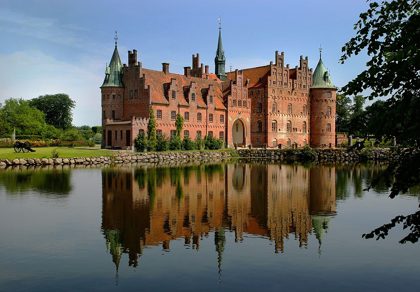
Egeskov Castle, completed in 1554 by royal marshal Frands Brockenhuus, is considered Europe's best-preserved Renaissance water castle. It sits on a small lake near Kværndrup on Funen, Denmark, its brick walls resting on oak pilings driven into the lakebed. The estate's name means 'oak forest,' recalling the trees felled for that foundation. Built as two long houses joined by a thick double wall and originally accessible only by drawbridge, it was designed as a refuge during the civil conflict of the Count's Feud.
Owned by the Ahlefeldt-Laurvig-Bille family since 1882, it is open to visitors. The grounds include 20 hectares of gardens, museums of vintage vehicles, and hedge mazes, drawing around 200,000 visitors a year.
Visitor information
- Location
- Funen
- Country
- Denmark
- Tier
- A (Magnificent, well worth a dedicated trip)
- Coordinates
- 55.1764, 10.4894
- Official site
- http://www.egeskov.dk
Frequently asked questions
- Where is Egeskov Castle?
- Egeskov Castle is in Funen, Denmark (approximately 55.1764, 10.4894).
- Can you visit Egeskov Castle?
- Yes — Egeskov Castle is open to visitors; see the official site at http://www.egeskov.dk for hours and tickets.
- What tier is Egeskov Castle on the Castle Atlas?
- Egeskov Castle is rated A tier on the Castle Atlas — Magnificent, well worth a dedicated trip.
- What can you see at Egeskov Castle?
- Egeskov Castle, completed in 1554 by royal marshal Frands Brockenhuus, is considered Europe's best-preserved Renaissance water castle. It sits on a small lake near Kværndrup on Funen, Denmark, its brick walls resting on oak pilings driven into the lakebed. The estate's name means 'oak forest,' recalling the trees felled for that foundation. Built as two long houses joined by a thick double wall and originally accessible only by drawbridge, it was designed as a refuge during the civil conflict of the Count's Feud.