Trakoscan Castle
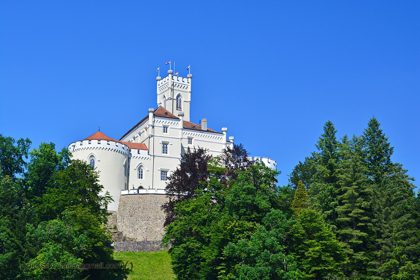
Trakošćan Castle crowns a wooded hill in Varaždin County, northern Croatia, originating as a 13th-century observation fortress monitoring routes through the Zagorje region. The Drašković family acquired it in 1584 by royal grant and held it for over three centuries. Between 1850 and 1860, nobleman Juraj VI Drašković restored the derelict fortress in Neo-Gothic style, adding an artificial lake and a Romanticist landscaped park.
State-owned since 1944, it now houses a permanent museum opened in 1953, displaying period furniture, armour, family portraits, and historic interiors. It attracts around 40,000 visitors a year and was ranked by Condé Nast Traveler among Europe's 12 most beautiful castles in 2017.
Visitor information
- Location
- Trakoscan
- Country
- Croatia
- Tier
- B (Great castles)
- Coordinates
- 46.2582, 15.947
- Official site
- http://www.trakoscan.hr
Frequently asked questions
- Where is Trakoscan Castle?
- Trakoscan Castle is in Trakoscan, Croatia (approximately 46.2582, 15.947).
- Can you visit Trakoscan Castle?
- Yes — Trakoscan Castle is open to visitors; see the official site at http://www.trakoscan.hr for hours and tickets.
- What tier is Trakoscan Castle on the Castle Atlas?
- Trakoscan Castle is rated B tier on the Castle Atlas — Great castles.
- What can you see at Trakoscan Castle?
- Trakošćan Castle crowns a wooded hill in Varaždin County, northern Croatia, originating as a 13th-century observation fortress monitoring routes through the Zagorje region. The Drašković family acquired it in 1584 by royal grant and held it for over three centuries. Between 1850 and 1860, nobleman Juraj VI Drašković restored the derelict fortress in Neo-Gothic style, adding an artificial lake and a Romanticist landscaped park.