Old Castle (Stuttgart)
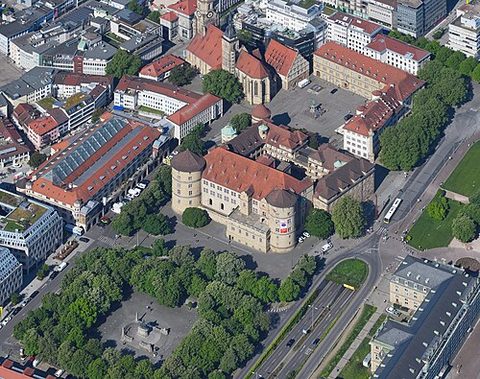
The Altes Schloss in Stuttgart's city centre originated as a moated castle in the second half of the 12th or early 13th century and served as the residence of the Counts of Württemberg from the 14th century. Architect Aberlin Tretsch and master builder Blasius Berwart transformed it into a Renaissance palace from 1553, completing the arcaded inner courtyard in 1557 and the castle chapel in 1562.
Fire on 21–22 December 1931 severely damaged the structure; World War II caused further destruction, and reconstruction under Paul Schmitthenner was completed in 1971. Today it houses the Landesmuseum Württemberg, with collections spanning the Stone Age through Roman antiquity to modern history, and is open to visitors.
Visitor information
- Location
- Germany
- Country
- Germany
- Tier
- C (Worth a visit if you're already in the area)
- Coordinates
- 48.777, 9.1797
Frequently asked questions
- Where is Old Castle (Stuttgart)?
- Old Castle (Stuttgart) is in Germany, Germany (approximately 48.777, 9.1797).
- Can you visit Old Castle (Stuttgart)?
- Yes — Old Castle (Stuttgart) is a recognised tourist attraction in Germany.
- What tier is Old Castle (Stuttgart) on the Castle Atlas?
- Old Castle (Stuttgart) is rated C tier on the Castle Atlas — Worth a visit if you're already in the area.
- What can you see at Old Castle (Stuttgart)?
- The Altes Schloss in Stuttgart's city centre originated as a moated castle in the second half of the 12th or early 13th century and served as the residence of the Counts of Württemberg from the 14th century. Architect Aberlin Tretsch and master builder Blasius Berwart transformed it into a Renaissance palace from 1553, completing the arcaded inner courtyard in 1557 and the castle chapel in 1562.