Königstein Fortress
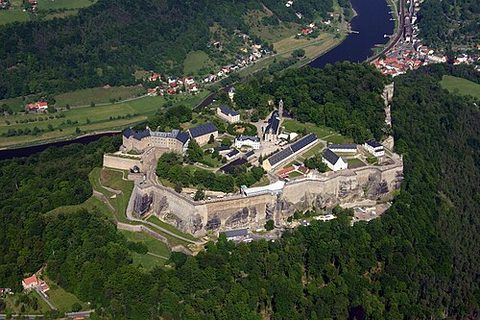
Königstein Fortress rises 240 metres above the River Elbe in the Elbe Sandstone Mountains of Saxony, Germany. First documented in 1233, the 9.5-hectare plateau holds more than 50 buildings accumulated over four centuries of Saxon rule, including a well sunk between 1563 and 1569 to a depth of 152.5 metres — the second-deepest castle well in Europe.
The fortress never fell to an enemy and served by turns as a royal treasury, arsenal, and dreaded state prison. Its inmates included the Russian anarchist Mikhail Bakunin and French General Henri Giraud, who escaped in 1942. Since 1955 it has operated as an open-air military history museum drawing hundreds of thousands of visitors each year, accessible by elevator from the base of the cliff.
Visitor information
- Location
- Germany
- Country
- Germany
- Tier
- B (Great castles)
- Coordinates
- 50.9189, 14.0567
- Official site
- http://www.festung-koenigstein.de/
Frequently asked questions
- Where is Königstein Fortress?
- Königstein Fortress is in Germany, Germany (approximately 50.9189, 14.0567).
- Can you visit Königstein Fortress?
- Yes — Königstein Fortress is open to visitors; see the official site at http://www.festung-koenigstein.de/ for hours and tickets.
- What tier is Königstein Fortress on the Castle Atlas?
- Königstein Fortress is rated B tier on the Castle Atlas — Great castles.
- What can you see at Königstein Fortress?
- Königstein Fortress rises 240 metres above the River Elbe in the Elbe Sandstone Mountains of Saxony, Germany. First documented in 1233, the 9.5-hectare plateau holds more than 50 buildings accumulated over four centuries of Saxon rule, including a well sunk between 1563 and 1569 to a depth of 152.5 metres — the second-deepest castle well in Europe.