Glücksburg Castle
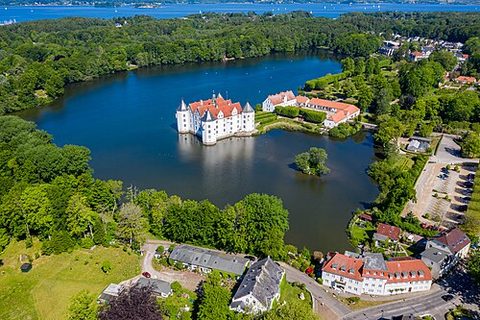
Glücksburg Castle is a Renaissance water castle in Schleswig-Holstein, northern Germany, built between 1582 and 1587 for Duke Johann of Schleswig-Holstein-Sonderburg on the site of a former Cistercian monastery. Three interconnected white-plastered brick buildings around a square courtyard rest on a granite foundation and are mirrored in an artificial lake.
The castle became the seat of the House of Glücksburg, whose descendants married into the royal families of Britain, Denmark, Greece, Norway, and Russia — earning it the epithet cradle of Europe. A foundation has managed the property since 1922; it now operates as a museum open to the public, with the surrounding gardens freely accessible year-round.
Visitor information
- Location
- Germany
- Country
- Germany
- Tier
- B (Great castles)
- Coordinates
- 54.8317, 9.5436
- Official site
- https://www.schloss-gluecksburg.de/
Frequently asked questions
- Where is Glücksburg Castle?
- Glücksburg Castle is in Germany, Germany (approximately 54.8317, 9.5436).
- Can you visit Glücksburg Castle?
- Yes — Glücksburg Castle is open to visitors; see the official site at https://www.schloss-gluecksburg.de/ for hours and tickets.
- What tier is Glücksburg Castle on the Castle Atlas?
- Glücksburg Castle is rated B tier on the Castle Atlas — Great castles.
- What can you see at Glücksburg Castle?
- Glücksburg Castle is a Renaissance water castle in Schleswig-Holstein, northern Germany, built between 1582 and 1587 for Duke Johann of Schleswig-Holstein-Sonderburg on the site of a former Cistercian monastery. Three interconnected white-plastered brick buildings around a square courtyard rest on a granite foundation and are mirrored in an artificial lake.