Carcassonne
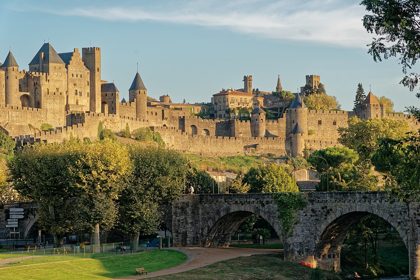
The Cité de Carcassonne is a medieval fortified city on a hill above the Aude River in southern France. Its defenses evolved across more than two millennia: Roman walls built from the 3rd century CE were extended by Visigoths, the Trencavel viscounts, and the French Crown after the Albigensian Crusade of 1209. The double ring of walls stretches nearly three kilometers, with 52 towers.
After the 1659 Treaty of the Pyrenees removed its strategic role, it decayed until architect Eugène Viollet-le-Duc began a controversial restoration in 1855. Designated a UNESCO World Heritage Site in 1997, it remains one of Europe's best-preserved medieval fortress towns. The Château Comtal and ramparts are open to visitors.
Visitor information
- Location
- Carcassonne, Occitanie
- Country
- France
- Tier
- S (The absolute cream of the castle crop)
- Coordinates
- 43.2066, 2.364
- Official site
- http://www.carcassonne.culture.fr/
Frequently asked questions
- Where is Carcassonne?
- Carcassonne is in Carcassonne, Occitanie, France (approximately 43.2066, 2.364).
- Can you visit Carcassonne?
- Yes — Carcassonne is open to visitors; see the official site at http://www.carcassonne.culture.fr/ for hours and tickets.
- What tier is Carcassonne on the Castle Atlas?
- Carcassonne is rated S tier on the Castle Atlas — The absolute cream of the castle crop.
- What can you see at Carcassonne?
- The Cité de Carcassonne is a medieval fortified city on a hill above the Aude River in southern France. Its defenses evolved across more than two millennia: Roman walls built from the 3rd century CE were extended by Visigoths, the Trencavel viscounts, and the French Crown after the Albigensian Crusade of 1209. The double ring of walls stretches nearly three kilometers, with 52 towers.