Bodiam Castle
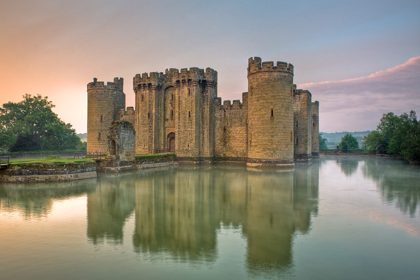
Bodiam Castle rises from its broad moat in East Sussex, built in 1385 by Sir Edward Dalyngrigge, a knight enriched by mercenary service in France during the Hundred Years' War. Richard II granted a licence to fortify in response to French raids threatening the Rother estuary.
Conceived in a single phase as a quadrangular fortress with no central keep — chambers lining outer walls around inner courts — it embodies the medieval castle ideal. The interior was dismantled after the English Civil War, but the shell of towers, gatehouse, and moat survives in remarkable condition. Lord Curzon restored it from 1916 and donated it to the National Trust in 1925; it featured as a filming location in Monty Python and the Holy Grail (1975) and draws around 175,000 visitors annually.
Visitor information
- Location
- East Sussex, England
- Country
- United Kingdom
- Tier
- B (Great castles)
- Coordinates
- 51.0023, 0.5435
- Official site
- https://www.nationaltrust.org.uk/bodiam-castle
Frequently asked questions
- Where is Bodiam Castle?
- Bodiam Castle is in East Sussex, England, United Kingdom (approximately 51.0023, 0.5435).
- Can you visit Bodiam Castle?
- Yes — Bodiam Castle is open to visitors; see the official site at https://www.nationaltrust.org.uk/bodiam-castle for hours and tickets.
- What tier is Bodiam Castle on the Castle Atlas?
- Bodiam Castle is rated B tier on the Castle Atlas — Great castles.
- What can you see at Bodiam Castle?
- Bodiam Castle rises from its broad moat in East Sussex, built in 1385 by Sir Edward Dalyngrigge, a knight enriched by mercenary service in France during the Hundred Years' War. Richard II granted a licence to fortify in response to French raids threatening the Rother estuary.
All castles in the United Kingdom · Explore the full Castle Atlas →