Hever Castle
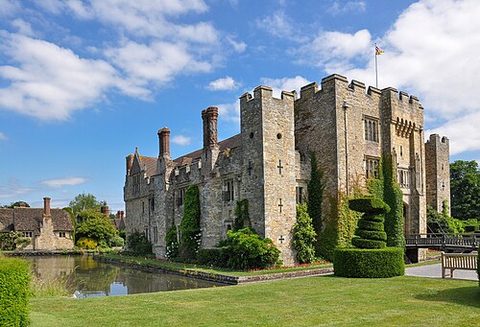
Hever Castle in Kent, England, began as a 13th-century fortified manor house and became the childhood home of Anne Boleyn after the Boleyn family acquired it in 1462. Henry VIII visited the estate while courting Anne, though he conducted much of that courtship at nearby Bolebroke Castle. After Anne's execution the crown acquired Hever and granted it to Anne of Cleves in 1540.
The castle fell into long decline until American millionaire William Waldorf Astor undertook a sweeping restoration from 1903, adding lavish Italian gardens and a mock-Tudor village. Today a Grade I listed building, it is open to the public with gardens, a maze, and rooms preserving Anne Boleyn's prayer books and Tudor furnishings.
Visitor information
- Location
- United Kingdom
- Country
- United Kingdom
- Tier
- B (Great castles)
- Coordinates
- 51.1869, 0.1139
- Official site
- http://www.hevercastle.co.uk/
Frequently asked questions
- Where is Hever Castle?
- Hever Castle is in United Kingdom, United Kingdom (approximately 51.1869, 0.1139).
- Can you visit Hever Castle?
- Yes — Hever Castle is open to visitors; see the official site at http://www.hevercastle.co.uk/ for hours and tickets.
- What tier is Hever Castle on the Castle Atlas?
- Hever Castle is rated B tier on the Castle Atlas — Great castles.
- What can you see at Hever Castle?
- Hever Castle in Kent, England, began as a 13th-century fortified manor house and became the childhood home of Anne Boleyn after the Boleyn family acquired it in 1462. Henry VIII visited the estate while courting Anne, though he conducted much of that courtship at nearby Bolebroke Castle. After Anne's execution the crown acquired Hever and granted it to Anne of Cleves in 1540.
All castles in the United Kingdom · Explore the full Castle Atlas →