Konopiště Castle
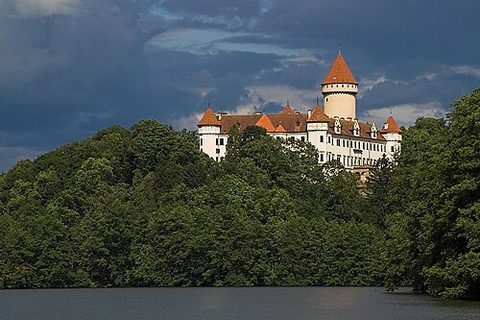
Konopiště Castle stands in Benešov, Central Bohemia, about 40 km southeast of Prague. Founded around 1294 as a Gothic fortress by Prague Bishop Tobiáš z Benešova, it passed through noble hands before Archduke Franz Ferdinand d'Este purchased it in 1887 and transformed it into a lavish residence, adding electricity, running water, and a hydraulic lift. He lived here until his assassination in Sarajevo in late June 1914 — the event that sparked World War I.
The Czechoslovak state confiscated it in 1919, ratified in 1921, and it has been open to visitors since 1971. The bullet that killed Franz Ferdinand is displayed in the castle's museum.
Visitor information
- Location
- Czechia
- Country
- Czechia
- Tier
- B (Great castles)
- Coordinates
- 49.7794, 14.6567
- Official site
- http://www.zamek-konopiste.cz/
Frequently asked questions
- Where is Konopiště Castle?
- Konopiště Castle is in Czechia, Czechia (approximately 49.7794, 14.6567).
- Can you visit Konopiště Castle?
- Yes — Konopiště Castle is open to visitors; see the official site at http://www.zamek-konopiste.cz/ for hours and tickets.
- What tier is Konopiště Castle on the Castle Atlas?
- Konopiště Castle is rated B tier on the Castle Atlas — Great castles.
- What can you see at Konopiště Castle?
- Konopiště Castle stands in Benešov, Central Bohemia, about 40 km southeast of Prague. Founded around 1294 as a Gothic fortress by Prague Bishop Tobiáš z Benešova, it passed through noble hands before Archduke Franz Ferdinand d'Este purchased it in 1887 and transformed it into a lavish residence, adding electricity, running water, and a hydraulic lift. He lived here until his assassination in Sarajevo in late June 1914 — the event that sparked World War I.