Coca Castle
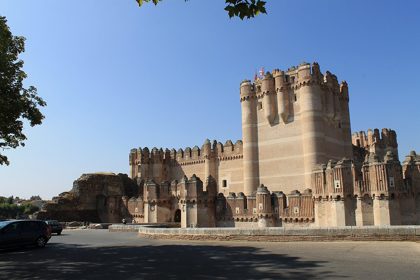
Coca Castle stands beside the River Voltoya in Coca, Segovia. In 1453 Archbishop Alonso de Fonseca obtained royal permission from Juan II of Castile to build it; his nephew Alonso de Fonseca y Avellaneda oversaw construction, largely complete by 1493. Built entirely of brick by Moorish craftsmen, it is a prime example of Gothic-Mudéjar architecture. A deep moat, two curtain walls, cylindrical corner towers, and a 25-m central keep provided strong defences.
Declared a national monument in 1926 and restored 1954–58, it now houses a forestry school open to visitors. The chapel retains 14th–16th-century artworks, and marble columns sold off in the 19th century were later repurchased and reinstated.
Visitor information
- Location
- Coca, Castile and Leon
- Country
- Spain
- Tier
- B (Great castles)
- Coordinates
- 41.2151, -4.5255
- Official site
- http://www.castillodecoca.com/
Frequently asked questions
- Where is Coca Castle?
- Coca Castle is in Coca, Castile and Leon, Spain (approximately 41.2151, -4.5255).
- Can you visit Coca Castle?
- Yes — Coca Castle is open to visitors; see the official site at http://www.castillodecoca.com/ for hours and tickets.
- What tier is Coca Castle on the Castle Atlas?
- Coca Castle is rated B tier on the Castle Atlas — Great castles.
- What can you see at Coca Castle?
- Coca Castle stands beside the River Voltoya in Coca, Segovia. In 1453 Archbishop Alonso de Fonseca obtained royal permission from Juan II of Castile to build it; his nephew Alonso de Fonseca y Avellaneda oversaw construction, largely complete by 1493. Built entirely of brick by Moorish craftsmen, it is a prime example of Gothic-Mudéjar architecture. A deep moat, two curtain walls, cylindrical corner towers, and a 25-m central keep provided strong defences.