Aljafería
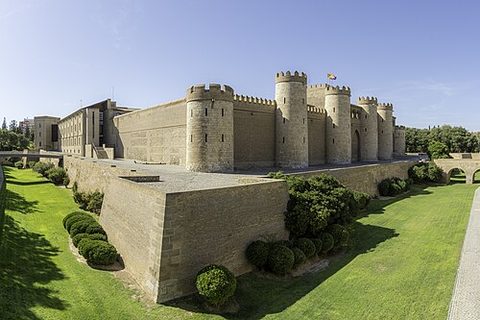
The Aljafería in Zaragoza, Spain, is a fortified palace built between 1065 and 1081 by Ahmad al-Muqtadir of the Banu Hud dynasty — the finest surviving Hispano-Muslim building from the taifa era. Its private mosque, gilded throne room (the Maylis al-Dahab), geometric stucco carvings, and mixtilinear interlocking arches make it a masterpiece of Andalusian design.
Alfonso I of Aragón retook Zaragoza in 1118, and the palace became a royal Aragonese residence. The Catholic Monarchs added an elaborate wing between 1488 and 1495. Philip II raised Renaissance fortifications in 1593; Charles III converted it to military barracks in 1772. Restoration began in 1947, and in 1984 it became the seat of the Cortes of Aragon. UNESCO listed it in 2001 as Mudéjar Architecture of Aragon.
Visitor information
- Location
- Spain
- Country
- Spain
- Tier
- B (Great castles)
- Coordinates
- 41.6565, -0.8971
Frequently asked questions
- Where is Aljafería?
- Aljafería is in Spain, Spain (approximately 41.6565, -0.8971).
- Can you visit Aljafería?
- Yes — Aljafería is a recognised tourist attraction in Spain.
- What tier is Aljafería on the Castle Atlas?
- Aljafería is rated B tier on the Castle Atlas — Great castles.
- What can you see at Aljafería?
- The Aljafería in Zaragoza, Spain, is a fortified palace built between 1065 and 1081 by Ahmad al-Muqtadir of the Banu Hud dynasty — the finest surviving Hispano-Muslim building from the taifa era. Its private mosque, gilded throne room (the Maylis al-Dahab), geometric stucco carvings, and mixtilinear interlocking arches make it a masterpiece of Andalusian design.