Loarre Castle
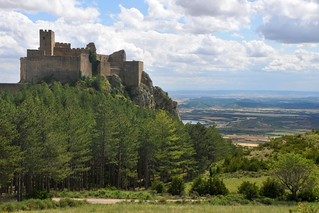
Standing on a rocky spur above the Hoya de Huesca plain in Aragon, the Castle of Loarre is widely regarded as the finest preserved Romanesque fortress in Europe. Construction began under King Sancho III of Pamplona around 1020–1033, and King Sancho Ramírez expanded it after 1071, founding an Augustinian monastery within its walls in 1073. The complex served as a frontier stronghold between Christian and Muslim territory during the Reconquista.
Its curtain walls, semicircular towers, and domed Romanesque chapel remain remarkably intact. Declared a National Monument in 1906, the castle is open to the public year-round and served as a filming location for Ridley Scott's 2005 epic Kingdom of Heaven.
Visitor information
- Location
- Huesca, Aragon
- Country
- Spain
- Tier
- B (Great castles)
- Coordinates
- 42.3156, -0.6242
- Official site
- https://castillo-loarre.es/
Frequently asked questions
- Where is Loarre Castle?
- Loarre Castle is in Huesca, Aragon, Spain (approximately 42.3156, -0.6242).
- Can you visit Loarre Castle?
- Yes — Loarre Castle is open to visitors; see the official site at https://castillo-loarre.es/ for hours and tickets.
- What tier is Loarre Castle on the Castle Atlas?
- Loarre Castle is rated B tier on the Castle Atlas — Great castles.
- What can you see at Loarre Castle?
- Standing on a rocky spur above the Hoya de Huesca plain in Aragon, the Castle of Loarre is widely regarded as the finest preserved Romanesque fortress in Europe. Construction began under King Sancho III of Pamplona around 1020–1033, and King Sancho Ramírez expanded it after 1071, founding an Augustinian monastery within its walls in 1073. The complex served as a frontier stronghold between Christian and Muslim territory during the Reconquista.