Malbork Castle
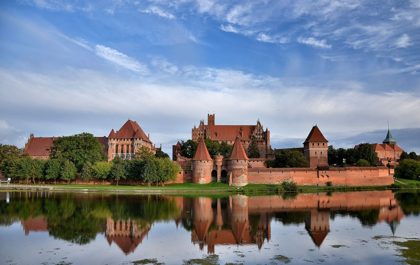
Malbork Castle on the Nogat River in northern Poland is the largest castle in the world by land area and the largest brick complex in Europe. Built by the Teutonic Knights from around 1274 and named Marienburg in honour of the Virgin Mary, it became the Order's capital in 1309 when Grand Master Siegfried von Feuchtwangen relocated from Venice. The three linked sections — High, Middle, and Lower Castles — once housed around 3,000 knights and controlled the Baltic amber trade.
After passing to Poland in 1457 it housed a royal mint, admiralty, and the Commonwealth's largest arsenal. Heavily damaged in 1945, it was meticulously restored and is now a UNESCO World Heritage Site and public museum.
Visitor information
- Location
- Malbork
- Country
- Poland
- Tier
- A (Magnificent, well worth a dedicated trip)
- Coordinates
- 54.0397, 19.0278
- Official site
- https://zamek.malbork.pl/en
Frequently asked questions
- Where is Malbork Castle?
- Malbork Castle is in Malbork, Poland (approximately 54.0397, 19.0278).
- Can you visit Malbork Castle?
- Yes — Malbork Castle is open to visitors; see the official site at https://zamek.malbork.pl/en for hours and tickets.
- What tier is Malbork Castle on the Castle Atlas?
- Malbork Castle is rated A tier on the Castle Atlas — Magnificent, well worth a dedicated trip.
- What can you see at Malbork Castle?
- Malbork Castle on the Nogat River in northern Poland is the largest castle in the world by land area and the largest brick complex in Europe. Built by the Teutonic Knights from around 1274 and named Marienburg in honour of the Virgin Mary, it became the Order's capital in 1309 when Grand Master Siegfried von Feuchtwangen relocated from Venice. The three linked sections — High, Middle, and Lower Castles — once housed around 3,000 knights and controlled the Baltic amber trade.