Lublin Castle
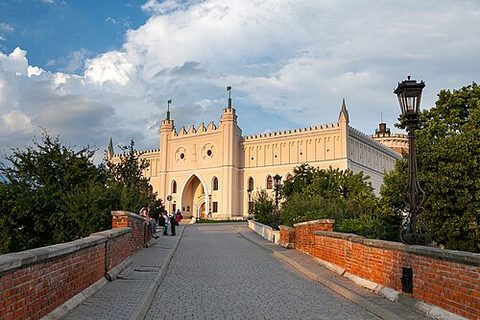
Royal fortress in Lublin, Poland, with origins in a 12th-century wood-reinforced earthen fortification. A stone keep was raised in the early 13th century; Casimir the Great rebuilt the complex with stone walls in the 14th century. The castle hosted the 1569 Sejm that created the Polish-Lithuanian Commonwealth via the Union of Lublin.
Its Chapel of the Holy Trinity contains a fresco cycle completed in 1418 by the Ruthenian master Andrej, blending Western and Eastern Orthodox influences and considered among the most valuable medieval artworks in Poland. The castle functioned as a prison for 128 years, including under Nazi occupation (1939–1944) when 40,000–80,000 inmates passed through. Since 1957 it houses the National Museum of Lublin.
Visitor information
- Location
- Poland
- Country
- Poland
- Tier
- C (Worth a visit if you're already in the area)
- Coordinates
- 51.2005, 22.5717
- Official site
- http://www.muzeumlubelskie.pl/
Frequently asked questions
- Where is Lublin Castle?
- Lublin Castle is in Poland, Poland (approximately 51.2005, 22.5717).
- Can you visit Lublin Castle?
- Yes — Lublin Castle is open to visitors; see the official site at http://www.muzeumlubelskie.pl/ for hours and tickets.
- What tier is Lublin Castle on the Castle Atlas?
- Lublin Castle is rated C tier on the Castle Atlas — Worth a visit if you're already in the area.
- What can you see at Lublin Castle?
- Royal fortress in Lublin, Poland, with origins in a 12th-century wood-reinforced earthen fortification. A stone keep was raised in the early 13th century; Casimir the Great rebuilt the complex with stone walls in the 14th century. The castle hosted the 1569 Sejm that created the Polish-Lithuanian Commonwealth via the Union of Lublin.