Castel del Monte
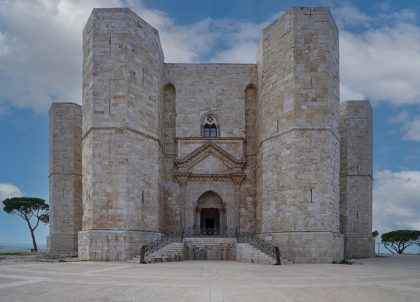
Castel del Monte crowns a hill at 540 metres on the Murge plateau near Andria in Apulia, southern Italy. Emperor Frederick II ordered its construction on 29 January 1240 in a unique octagonal plan: eight octagonal corner towers, two floors of eight rooms each, and a central octagonal courtyard, with the main portal aligned to the equinox sunrise. Its precise purpose — hunting lodge, symbolic monument, or scholarly retreat — remains debated.
Under Charles I of Anjou it became a state prison, and members of the House of Bourbon later stripped its marble for their palace at Caserta. Purchased by the Italian state in 1876, it was declared a UNESCO World Heritage Site in 1996. Its outline appears on Italy's one-cent euro coin.
Visitor information
- Location
- Andria, Apulia
- Country
- Italy
- Tier
- B (Great castles)
- Coordinates
- 41.0848, 16.2709
- Official site
- https://www.casteldelmonte.beniculturali.it/
Frequently asked questions
- Where is Castel del Monte?
- Castel del Monte is in Andria, Apulia, Italy (approximately 41.0848, 16.2709).
- Can you visit Castel del Monte?
- Yes — Castel del Monte is open to visitors; see the official site at https://www.casteldelmonte.beniculturali.it/ for hours and tickets.
- What tier is Castel del Monte on the Castle Atlas?
- Castel del Monte is rated B tier on the Castle Atlas — Great castles.
- What can you see at Castel del Monte?
- Castel del Monte crowns a hill at 540 metres on the Murge plateau near Andria in Apulia, southern Italy. Emperor Frederick II ordered its construction on 29 January 1240 in a unique octagonal plan: eight octagonal corner towers, two floors of eight rooms each, and a central octagonal courtyard, with the main portal aligned to the equinox sunrise. Its precise purpose — hunting lodge, symbolic monument, or scholarly retreat — remains debated.