Castel Sant'Angelo
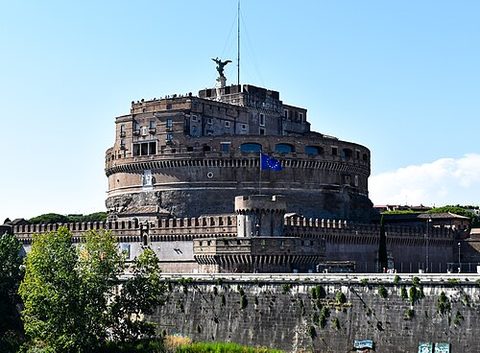
Castel Sant'Angelo is a cylindrical fortress on the Tiber's right bank in Rome, originally built as Emperor Hadrian's mausoleum and completed in 139 CE. It held imperial ashes through the early 3rd century, was incorporated into the Aurelian Walls in 403 CE, and became a papal stronghold. Pope Nicholas III connected it to the Vatican via the covered Passetto di Borgo corridor, which sheltered Pope Clement VII during the 1527 Sack of Rome. It also served as a state prison, holding philosopher Giordano Bruno among others.
Decommissioned in 1901, it now operates as the Museo Nazionale di Castel Sant'Angelo across seven levels. The name comes from a 590 CE vision in which Pope Gregory I saw the Archangel Michael atop the fortress, taken as a sign that a devastating plague had ended.
Visitor information
- Location
- Italy
- Country
- Italy
- Tier
- A (Magnificent, well worth a dedicated trip)
- Coordinates
- 41.903, 12.4663
- Official site
- http://www.castelsantangelo.beniculturali.it/
Frequently asked questions
- Where is Castel Sant'Angelo?
- Castel Sant'Angelo is in Italy, Italy (approximately 41.903, 12.4663).
- Can you visit Castel Sant'Angelo?
- Yes — Castel Sant'Angelo is open to visitors; see the official site at http://www.castelsantangelo.beniculturali.it/ for hours and tickets.
- What tier is Castel Sant'Angelo on the Castle Atlas?
- Castel Sant'Angelo is rated A tier on the Castle Atlas — Magnificent, well worth a dedicated trip.
- What can you see at Castel Sant'Angelo?
- Castel Sant'Angelo is a cylindrical fortress on the Tiber's right bank in Rome, originally built as Emperor Hadrian's mausoleum and completed in 139 CE. It held imperial ashes through the early 3rd century, was incorporated into the Aurelian Walls in 403 CE, and became a papal stronghold. Pope Nicholas III connected it to the Vatican via the covered Passetto di Borgo corridor, which sheltered Pope Clement VII during the 1527 Sack of Rome. It also served as a state prison, holding philosopher Giordano Bruno among others.