Sforza Castle
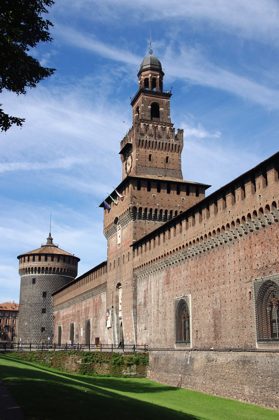
Sforza Castle stands at the edge of Milan's historic centre behind walls up to seven metres thick. A first fortress was ordered in 1358 by Galeazzo II Visconti; after the Ambrosian Republic demolished it in 1447, Francesco Sforza rebuilt it from 1450 as his ducal residence. Leonardo da Vinci and Bramante both worked here under Ludovico il Moro from 1494.
The Torre del Filarete exploded in 1521 when used as a weapons depot and was rebuilt between 1900 and 1905 under Luca Beltrami's restoration — Napoleon had ordered total demolition in 1800. Today it houses several civic museums, including the room containing Michelangelo's unfinished Rondanini Pieta and the Codex Trivulzianus, Leonardo's early notebook.
Visitor information
- Location
- Milan
- Country
- Italy
- Tier
- B (Great castles)
- Coordinates
- 45.47, 9.1786
- Official site
- http://www.milanocastello.it/
Frequently asked questions
- Where is Sforza Castle?
- Sforza Castle is in Milan, Italy (approximately 45.47, 9.1786).
- Can you visit Sforza Castle?
- Yes — Sforza Castle is open to visitors; see the official site at http://www.milanocastello.it/ for hours and tickets.
- What tier is Sforza Castle on the Castle Atlas?
- Sforza Castle is rated B tier on the Castle Atlas — Great castles.
- What can you see at Sforza Castle?
- Sforza Castle stands at the edge of Milan's historic centre behind walls up to seven metres thick. A first fortress was ordered in 1358 by Galeazzo II Visconti; after the Ambrosian Republic demolished it in 1447, Francesco Sforza rebuilt it from 1450 as his ducal residence. Leonardo da Vinci and Bramante both worked here under Ludovico il Moro from 1494.