Castel Nuovo
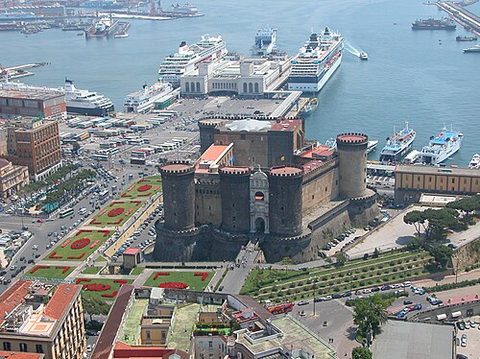
Castel Nuovo — also known as Maschio Angioino — dominates the waterfront at Piazza Municipio in Naples. Charles I of Anjou commissioned it in 1279 and it was complete by 1282. Alfonso V of Aragon had it rebuilt from 1453 onward; Catalan architect Guillem Sagrera added five cylindrical towers — four clad in dark piperno stone, one in tufa — and a celebrated Renaissance triumphal arch at the entrance. Giotto painted frescoes in its Palatine Chapel around 1330, and Petrarch and Boccaccio were guests at the Angevin court of Robert of Naples. On 13 December 1294 Pope Celestine V renounced the papacy within its walls.
The castle is open to the public and houses a civic museum and the library of the Neapolitan Society of National History.
Visitor information
- Location
- Italy
- Country
- Italy
- Tier
- C (Worth a visit if you're already in the area)
- Coordinates
- 40.8384, 14.2538
- Official site
- https://www.comune.napoli.it/home
Frequently asked questions
- Where is Castel Nuovo?
- Castel Nuovo is in Italy, Italy (approximately 40.8384, 14.2538).
- Can you visit Castel Nuovo?
- Yes — Castel Nuovo is open to visitors; see the official site at https://www.comune.napoli.it/home for hours and tickets.
- What tier is Castel Nuovo on the Castle Atlas?
- Castel Nuovo is rated C tier on the Castle Atlas — Worth a visit if you're already in the area.
- What can you see at Castel Nuovo?
- Castel Nuovo — also known as Maschio Angioino — dominates the waterfront at Piazza Municipio in Naples. Charles I of Anjou commissioned it in 1279 and it was complete by 1282. Alfonso V of Aragon had it rebuilt from 1453 onward; Catalan architect Guillem Sagrera added five cylindrical towers — four clad in dark piperno stone, one in tufa — and a celebrated Renaissance triumphal arch at the entrance. Giotto painted frescoes in its Palatine Chapel around 1330, and Petrarch and Boccaccio were guests at the Angevin court of Robert of Naples. On 13 December 1294 Pope Celestine V renounced the papacy within its walls.