Fenis Castle
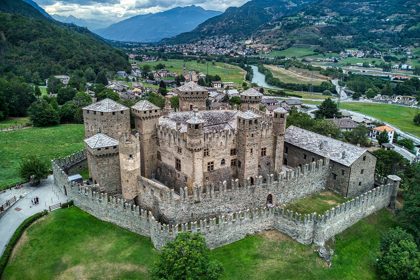
Fénis Castle sits on a low hilltop in Italy's Aosta Valley, about 13 km east of Aosta. First documented in 1242 under the Challant family, it took its present form from roughly 1320 onward: Aymon of Challant built the pentagonal outer walls and towers, while his son Boniface I added the inner courtyard, wooden balconies, and a semicircular staircase from 1392.
Despite its double crenellated walls it was built primarily as a residence. The courtyard holds late-Gothic frescoes attributed to the workshop of Giacomo Jaquerio. Sold to the Italian state in 1895, it is now owned by the Aosta Valley region, accessible only through guided tours, and draws over 80,000 visitors a year.
Visitor information
- Location
- Fenis, Aosta Valley
- Country
- Italy
- Tier
- B (Great castles)
- Coordinates
- 45.7369, 7.489
- Official site
- http://www.regione.vda.it/cultura/patrimonio/castelli/castello_fenis/default_i.asp
Frequently asked questions
- Where is Fenis Castle?
- Fenis Castle is in Fenis, Aosta Valley, Italy (approximately 45.7369, 7.489).
- Can you visit Fenis Castle?
- Yes — Fenis Castle is open to visitors; see the official site at http://www.regione.vda.it/cultura/patrimonio/castelli/castello_fenis/default_i.asp for hours and tickets.
- What tier is Fenis Castle on the Castle Atlas?
- Fenis Castle is rated B tier on the Castle Atlas — Great castles.
- What can you see at Fenis Castle?
- Fénis Castle sits on a low hilltop in Italy's Aosta Valley, about 13 km east of Aosta. First documented in 1242 under the Challant family, it took its present form from roughly 1320 onward: Aymon of Challant built the pentagonal outer walls and towers, while his son Boniface I added the inner courtyard, wooden balconies, and a semicircular staircase from 1392.