Castel Sant'Elmo
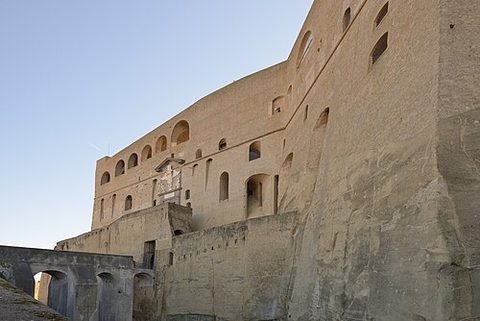
Castel Sant'Elmo crowns the Vomero hill 250 metres above Naples, commanding sweeping views over the city and the Gulf of Naples. King Robert the Wise began construction in 1329 and it was completed in 1343. It was radically rebuilt between 1537 and 1546 under Spanish viceroy Pedro de Toledo by Valencian architect Pedro Luis Escrivà into a bold six-pointed star plan — a design Escrivà publicly defended in a printed Apologia in 1538. The castle later served as a prison, holding philosopher Tommaso Campanella from 1604 to 1608.
Military use ended in 1952, and the castle opened to the public in 1988. It now houses the Museo Napoli Novecento with permanent exhibitions of 20th-century Neapolitan art, temporary shows, and a 700-seat auditorium carved into its underground chambers.
Visitor information
- Location
- Italy
- Country
- Italy
- Tier
- C (Worth a visit if you're already in the area)
- Coordinates
- 40.8436, 14.2393
- Official site
- http://www.musei.campania.beniculturali.it
Frequently asked questions
- Where is Castel Sant'Elmo?
- Castel Sant'Elmo is in Italy, Italy (approximately 40.8436, 14.2393).
- Can you visit Castel Sant'Elmo?
- Yes — Castel Sant'Elmo is open to visitors; see the official site at http://www.musei.campania.beniculturali.it for hours and tickets.
- What tier is Castel Sant'Elmo on the Castle Atlas?
- Castel Sant'Elmo is rated C tier on the Castle Atlas — Worth a visit if you're already in the area.
- What can you see at Castel Sant'Elmo?
- Castel Sant'Elmo crowns the Vomero hill 250 metres above Naples, commanding sweeping views over the city and the Gulf of Naples. King Robert the Wise began construction in 1329 and it was completed in 1343. It was radically rebuilt between 1537 and 1546 under Spanish viceroy Pedro de Toledo by Valencian architect Pedro Luis Escrivà into a bold six-pointed star plan — a design Escrivà publicly defended in a printed Apologia in 1538. The castle later served as a prison, holding philosopher Tommaso Campanella from 1604 to 1608.